
2021 in review. @ Irrational Exuberance
Hi folks,
This is the weekly digest for my blog, Irrational Exuberance. Reach out with thoughts on Twitter at @lethain, or reply to this email.
Posts from this week:
-
2021 in review.
-
The terminal level rulebook.
-
Should you write a technical or management book?
2021 in review.
Previously: 2020, 2019, 2018, 2017
It’s always tricky to figure out the right tone for an annual wrapup post. This has been one of the best years of my life. Our son is now firmly a toddler. I released Staff Engineer and it’s sold about 20,000 copies. I learned a tremendous amount supporting the engineering and data science teams at Calm. My weekly basketball game resumed after a 15 month hiatus. A secondary transaction at a previous company meaningfully changed my life financially. I angel invested for the first, second, and third times. There’s a version of this post that stops there–what an amazing year!
A more honest version goes further. It’s been a challenging year. While I’ve been fortunate to fully recover, I experienced a stroke and even a fast recovery feels slow while you’re inside it. Pandemic parenting is hard. I haven’t gotten to see my east coast family in person for over two years. How to balance out those threads to judge the year? Who knows! It was pretty good.
Goals
Back in 2019, I set goals for the decade rather than annual goals. This is a decision that I continue to appreciate, as the shape of each year is rather hard to predict ahead of time. Checking on those goals a bit:
- Do more learning experiments each year. Try new technologies, software, etc. My biggest learning experiments this year were self-publishing Staff Engineer and dipping my toes into angel investing for the first time.
- Write roughly one new talk each year, and present it somewhere. For each talk, identify some aspect of speaking that I want to improve on, and focus on improving in that area. I’ve decided to drop this goal going forward. At this point I’ve done enough conference speaking to know that it isn’t something I love doing. I may well do more of it, but I won’t be thinking of it as a goal.
- Write at least four good blog posts each year. Hmm, I’d honestly grade this as a miss. My implied definition of “good” is actually “industry moving” and I don’t think any of my blogging this year met that threshold, even though I think some of it was good.
- 3-5 folks who I’ve managed or “mentored” move into VPE or CTO roles at 100+ or $1B+ companies. This goal turns out to be a lot fuzzier than I intended, but I think a reasonable answer here is “two.” (Why? Folks tend to label mentorship in a self-serving way, “I mentor lots of people”, and I’ve managed quite a few folks as a “safe pair of hands” during company reorgs but I don’t think I impacted their careers in any meaningful way.) If valuations continue to accelerate, this is probably an overly conservative goal.
- Become an official advisor for 1-3 startups. No direct movement here, although the angel investing experience feels like indirect progress.
- Invest money in 3-5 startups. This year I did complete this goal, investing in three startups and one fund as an LP. I plan to continue doing a small amount of angel investing guided by my investment policy statement.
- Become a board member of a small company, startup or non-profit. No movement.
- Write a book about infrastructure engineering. No movement.
- Write another book about engineering or engineering management. Completed! Staff Engineer is published.
- Start a small but real business that I can run with a small amount of ongoing time investment. Some folks would consider self-publishing Staff Engineer a business that is selling an info product, but that’s not really the intent I had when writing this goal, so I rate this as no movement.
Overall, I remain pretty happy with these goals and my progress against them, particularly given what a messy year it was for society at large and also me personally. At some point, I do plan to refresh the goals a bit, maybe at the end of next year.
Staff Engineer
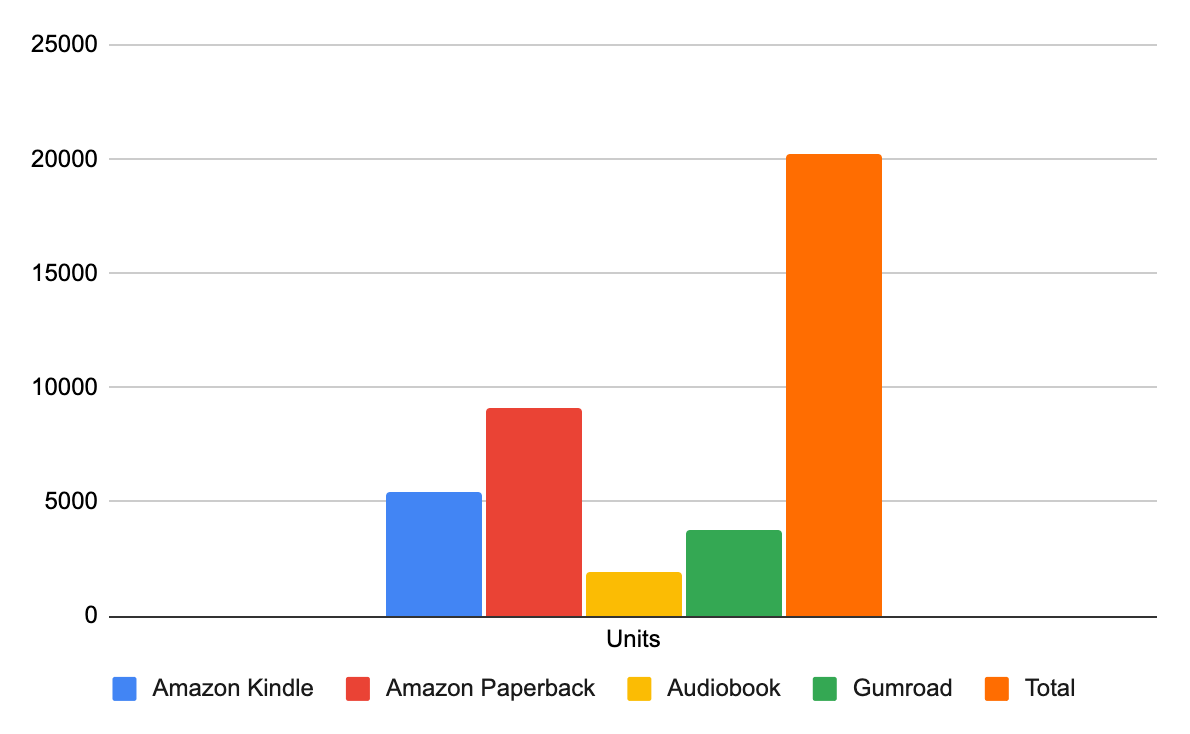
Sales figures pulled on on 11/20. Amazon numbers are through October, 2022.
Sales figures by channel for Staff Engineer
Staff Engineer was my big project for the year, although much of the work happened in 2020 and I haven’t worked on it much since July. I’m very excited to see the project continuing to evolve thanks to David and Alex’s work on the StaffEng podcast, as well as recent story submissions like Rebecca Panja’s.
Sales have been good, totalling 20,268 units sold when I pulled these numbers. The breakdown across channels is 5,394 on Amazon Kindle, 9,110 on Amazon paperback, 3,806 on Gumroad, and 1,958 on Audible audiobooks. In aggregate this is roughly $200k USD in sales. Of those proceeds, I’ve donated $100k thus far and will donate the remainder after getting final numbers for the year to determine appropriate tax withholdings.
The thing that has excited me the most is folks who’ve reached out to share the book’s impact on their career. This was an example of an important lesson I’ve learned over the years: we can change our industry by impacting individual lives.
While Staff Engineer is a nice book, the best possible outcome is that it helps financially validate this topic for other authors and publishers, which is why I’m quite excited to see Tanya Reilly’s The Staff Engineer’s Path coming next year and hope to see even more beyond that.
An Elegant Puzzle
Sales figures current through Q3, 2022.
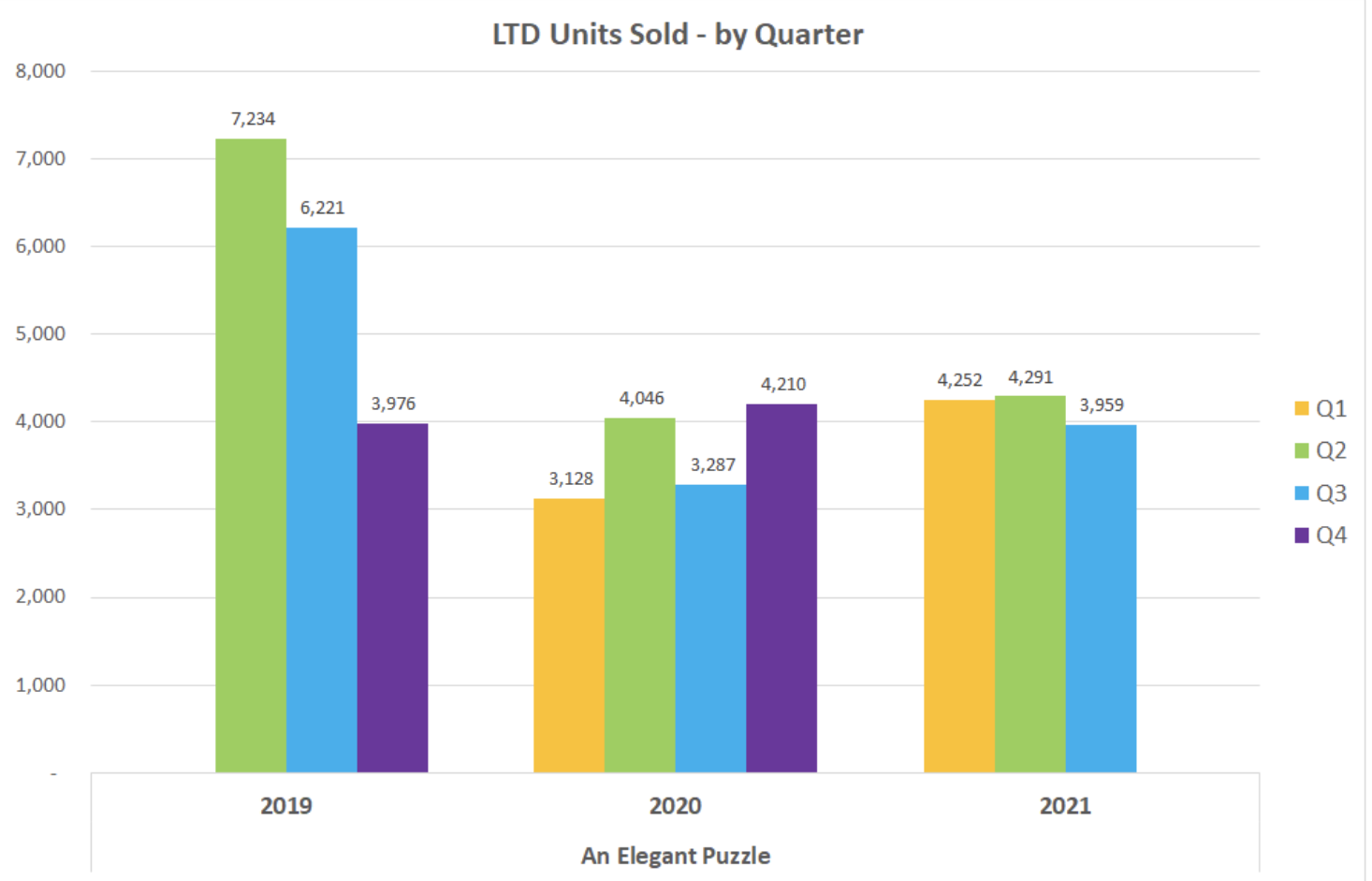
An Elegant Puzzle was published in 2019, and this year it kept humming along. Presumably the publication of Staff Engineer boosted sales here a bit, although I don’t have any clear proof. I don’t have Q4 numbers yet, but it passed 44,000 copies sold in Q3. An even more exciting milestone is that its second printing is happening. We launched with 27,000 hardcover copies and that was expected to cover the book’s lifetime, so this is pretty neat.
Although I can’t take any credit, Stripe Press also launched new book pages, which look rather nice.
Irrational Exuberance
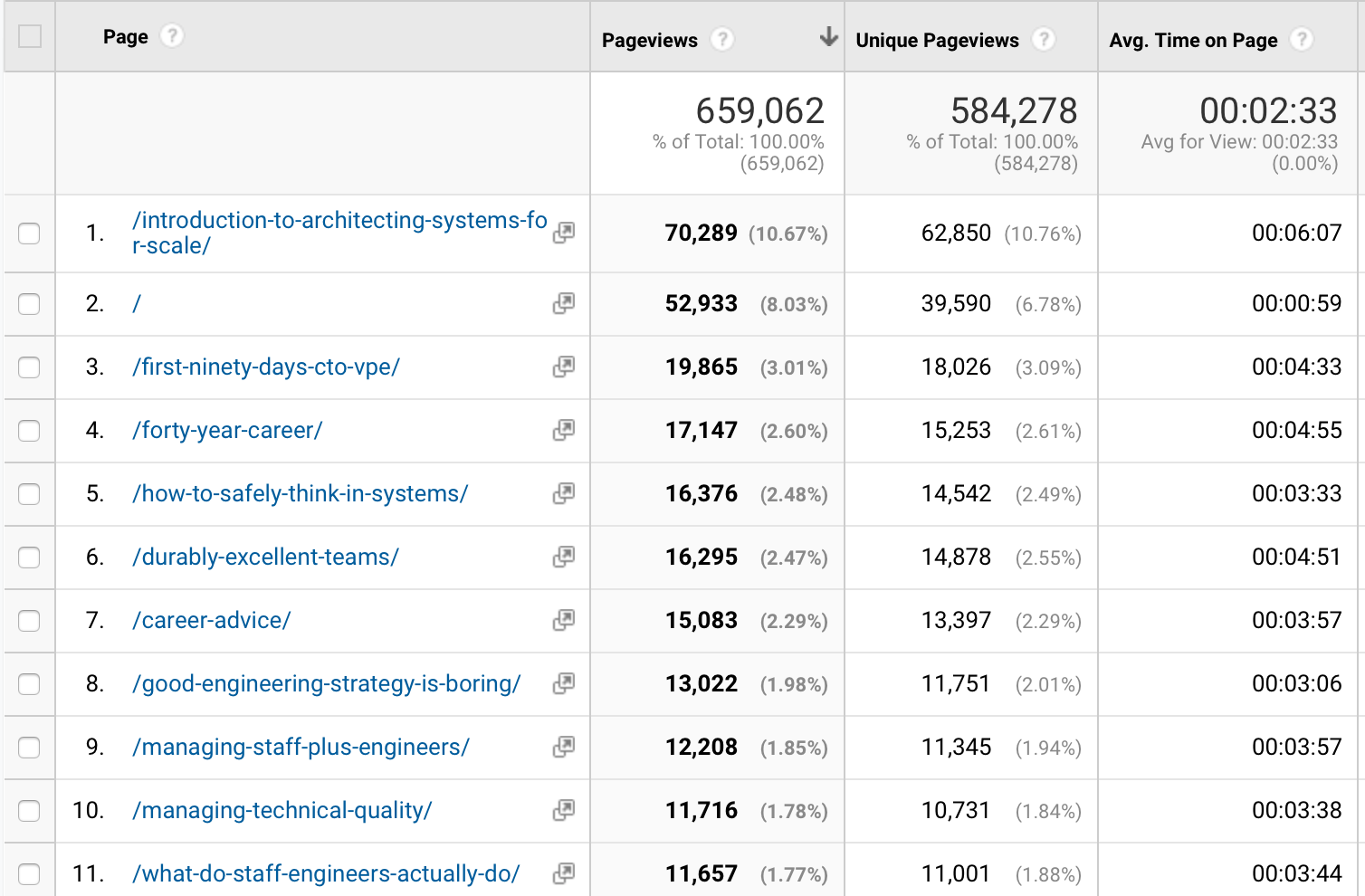
Google Analytics metrics pulled in early November for trailing 12 months.

I wrote 25 blog posts in 2021. Some of my favorite posts this year were: How to safely think in systems, Measures of engineering impact, How to be a tech influencer, and Learning about personal finances. Compared to last year’s eighty posts, it was a low volume year. The lower volume was primarily due to launching Staff Engineer and resting afterwards.
Except for How to safely think in systems (16k views), my best performing content is stuff from earlier years. This is expected, although a bit intimidating when contemplating the value of additional writing. Mailing list traffic isn’t considered here, but even more importantly content performance fits the typical a-few-hits-plus-long-tail curve distribution. It really does highlight how difficult it is for content to crack into long-term relevance, with even Migrations slipping towards obscurity a bit (16th best).
The blog also migrated from a complex setup I put together to learn about GCP and Kubernetes in 2018 to a static website built using Hugo. It’s much simpler, no longer has moving parts to maintain (looking at you, Let’s Encrypt), and is free rather than $100/month. Huge improvement to not be fiddling with all the underlying pieces.
CTO & VPE Learning Circle
The CTO/VPE Learning circle that I put together in early 2020 is continuing to go well, and I’ve moved from running it to co-running it with Uma Chingunde who leads the engineering team at Render. We’ve been good at organically finding folks to bring into the group to keep participation steady even as some folks get busy and drop out. This takes little ongoing preparation and is a delightful two hours of my month. I’ve also met a lot of really capable folks that I simply wouldn’t have met otherwise.
TechWriters
In 2020, I partnered with Gergely Orosz to launch TechWriters. TechWriters followed the Rands Leadership Slack model, but instead focusing on engineering leadership looking for folks creating technical content online. I really enjoyed this community but ultimately I did decide to withdraw earlier this year. Community moderation requires an ongoing and unpredictable energy outlay that I wasn’t able to maintain at that point.
Angel Investing
There’s so much image management in Silicon Valley that it can be hard to tell what’s real. I’ve found that particularly true for angel investing. Is this a useful way to spend time? Can you influence the industry’s evolution through intentional angel investment? Is it fun?
Trying to answer those questions, my wife and I invested small amounts in three companies and into one fund over the past year. We thought through what appropriate financial thresholds are for our angel investing, which we memorialized in our investment policy statement. Our baseline assumption is that everything we angel invest will go to zero. We’ll keep doing a small amount of angel investing as long as we keep learning from it, and will stop if the learning slows.
That’s my annual year in review for 2021. If you’re writing one, please send it my way! Love to hear what folks are working on and thinking about over the course of years.
The terminal level rulebook.
At work, the Staff Engineer cohort has a monthly meeting. The agenda varies but most recently we talked about a common theme: how do you find career progression after reaching your organization’s terminal level?
Reaching the terminal level has a lot in common with graduating from your last educational environment (graduate school, high school, or whatever). Before you graduate, you have clear grades, graduation requirements, exams, and someone else is responsible for teaching you how it works. After you graduate, there’s no framework at all. The good news is that the previous system was an artifice. Your real goal was to learn as opposed to getting grades that represent learning. The bad news is that you have to learn to measure progress without the comfort of an artificial gauge.
As I get deeper into my career, I’ve tried to frame progress through my own career goals rather than a career ladder. I’ve also become skeptical of the artificial competition that career ladders deliberately create, but removing training wheels doesn’t inherently teach you how to ride a bike, so here are my rules for succeeding at the terminal levels:
- There are still rules, they’re just poorly documented. After reaching the terminal level, the key thing to remember is that the road’s still there, it’s just unlabeled. If you convince yourself that there are no rules, you’ll end up misaligned and frustrated. It’s surprisingly common to see folks at terminal level get lost pursuing technically interesting work or “fun” technologies. These folks tend to exit well-managed organizations. You’ve gotta learn and follow the new, implied rules to stay aligned with authority.
- Relationships outweigh rules. Rules are reinforced so often as you climb the career ladder that it’s easy to forget that someone created those rules, and those creators are now your peers. Rules just don’t work as well at the top of the career ladder because the population is so small. It can feel fair to apply the same rule to two hundred employees you consider from afar, but parents know the impossibility of fairly treating two individuals when you know them both very well. If you aren’t investing into your relationships with senior stakeholders, you’re ignoring this rules of the terminal levels.
- There are many available projects but they are either urgent or ambiguous. Sometimes you’ll hear the meme that there are only a small number of company critical projects available, but my experience is that there is always a surplus of critical projects. It’s just that they’re difficult projects in one of two ways. Either they’re urgent with a fixed schedule driven by an external deadline or the project is missing someone capable of processing its surrounding ambiguity. The first category is probably familiar, so a quick example of the second: data locality. Data locality laws keep changing and your company’s international expansion plan will keep changing. It’s impossible to make forward progress on that sort of project without making simplifying assumptions despite knowing that some of them will be wrong. Most folks struggle to engage with problems where every aspect is unanchored and these projects remain unassigned (you could change the launch schedule, you could change your data architecture, you could change launch countries, you could introduce a regional vendor, you could…).
- If you get stuck, move. When folks talk about the opportunities of working at a large company, they always mention that you can change your role every year or two to keep engaged. You can move around even at smaller companies, but there are often enough disadvantages that folks decide to stay put. At the terminal level, you’re released from most of the downsides to moving teams (reset progress on your next promotion, etc), and you bring with you sufficient organizational authority to accelerate whatever you switch towards. There’s always new things to learn in a different environment, even if it’s within the same company.
Hopefully these rules are enough to spark some internal dialog about how you want to spend your time and attention now that you’ve graduated to the terminal level. If the road is feeling too long or too wide open, then work with peers, friends or your manager to bring some structure to it. Structure is really helpful, but remember that now the structure is purely your tool rather than the organization’s.
If it isn’t serving you, it’s up to you to change it.
Should you write a technical or management book?
Since publishing my second book, Staff Engineer, I’ve had more folks popping up for publishing advice. I’ve written a few times about my experience writing books in Self-publishing Staff Engineer (2021) and What I learned writing a book (2019), but neither directly confronts the two questions that folks keep asking, “Should I write a book?” and “How do I publish a book?”
Should I write a book?
When folks ask me this question, my first advice is that you should only write a book if you think you’d enjoy writing a book. There is always a more direct approach to your goals than writing a book. My second advice is that you have to answer a fairly predictable question, “What are your goals for writing a book?”
For every common goals that I hear, there’s usually a more direct solution than writing a book:
- “Increase access to future opportunities.” Access to future opportunities depends on your credibility and your qualified network (e.g. folks who will recommend you wholeheartedly rather than knowing you at a distance). A decent book does build credibility, but it doesn’t do too much to build your network. A more direct way to work on credibility and network is to work at a prestigious company. To work on credibility directly it’s easier to do some public speaking, or to write a few blog posts and get distribution on someone else’s blog like First Round Review.
- “Advance the state of the industry.” Advancing the industry requires the industry reading your work, and that only happens with an effective marketing and distribution plan. Working with a publisher helps a bit, but most of the work is still yours to do. Once again, a more direct way is blogging and public speaking. It takes vastly less time to write four great blog posts than one good book. It’s also much easier to incorporate feedback and suggestions into a blog post to take it from good to great than a book.
- “Alternative money stream.” Self-published books can make a fair amount of money. Eight months of Staff Engineer sales handily eclipsed my first salary as a software engineer, but most books make less and sales tend to be concentrated in the first six months. Books can indirectly make quite a bit of money as e.g. lead generation for your consultancy practice, but are not a very efficient way to directly make money.
If the book format still appeals to you, you’re an experienced writer, and those bullets don’t discourage you, then by all means write a book! Keep in mind that following default norms will push you towards writing something that’s two to three hundred pages, but you can absolutely write a shorter book. Let your goal guide your approach without worrying too much about norms.
Of course, that’s not always so easy if you’re working with a publisher, which brings us to the next topic.
How do I publish a book?
Most folks who haven’t published a book before think that deciding between self-publishing and working with a publisher is one of the final decisions to make in publishing a book. However, this is actually one of the very first decisions. Pushing would-be authors to acknowledge this is an early decision is probably the most valuable thing I do in these discussions.
Publishers have a process for creating a book, and they’re going to run you through that process. Even if you’ve already written your book, they’re going to still run you through that process, which will likely result in your reworking your book considerably. If you want to work with a publisher, you should reach out to them with a concept and an outline, and they’ll evaluate your concept very much along the lines that a venture capitalist might evaluate a startup:
- What is the audience you’re targeting?
- What gap would this book fill for that audience?
- What are the existing books for this audience? How did they sell? Why would this be an effective addition?
- Why are you an effective person to write this book?
- How will you make marketing this book easier?
If these questions seem annoying, then maybe you don’t really want to publish a book. These are really important questions to answer if you want to self-publish a well-read book as well. If you decide to self-publish to avoid answering those questions upfront, rest assured that you’ll need to answer them any many other logistical questions. I documented that process for Staff Engineer in Self-publishing Staff Engineer, and it includes things ranging from marketing to cover design.
My general advice to folks is to try working with a publisher for your first book. There is so much to learn about writing a book and a publisher lets you focus more on writing (and rewriting) a good book instead of the entire ecosystem. It also lends credibility that translates to future projects whether or not you work with a publisher. If you can’t get interest from publishers, then absolutely self-publish, but be prepared for a bit of a learning curve.
There’s certainly more topics on writing a book, but if you have solid answers to both of those then I think the others will fall into place.
That's all for now! Hope to hear your thoughts on Twitter at @lethain!
|

