
Build a network of peers. @ Irrational Exuberance
Hi folks,
This is the weekly digest for my blog, Irrational Exuberance. Reach out with thoughts on Twitter at @lethain, or reply to this email.
Posts from this week:
-
Build a network of peers.
-
Using QR Codes in printed books.
Build a network of peers.
This is a draft guide for staffeng.com.
As I talk to more and more Staff-plus engineers about career advice, the most consistent recommendation was to develop a personal network of peers doing similar work. Not every person emphasized this approach, but more than half mentioned it and for those who did it tended to be their first and strongest recommendation.
Ritu Vincent said,
What’s been most impactful for me is having a lot of people who I think of as mentors, usually friends, former managers and folks that I’ve worked with. I have a decent number of recurring monthly lunches, coffee chats and dinners with people who’ve worked with me in the past, know me, and I trust. It’s those conversations about career challenges and growth that have gotten me to where I am in my career.
Keavy McMinn mentioned her network as an important way to get honest feedback,
The thing that springs to mind is to find your peers or support network. Just like management, it gets lonely the higher up you go and it’s important to find peers that will still challenge you and you can brainstorm ideas with. It doesn’t even matter if they’re in your similar area of work or even are in different companies.
Nelson Elhage similarly shared,
It’s also been really valuable for me to cultivate a good personal network of other senior engineers. I chat with them informally about whatever it is that we're working on and thinking about. When you have personal connections, you can get very unvarnished views of the problems people are seeing and the solutions they're considering.
While it’s helpful to know you should build a network, some folks struggle to figure out how to do it. Among the various tactics to build your network, the two most common strategies are: being easy to find, and networking internally.
Being visible
There is so much pent-up demand for community among Staff-plus engineers that the easiest way to build your network is being easy to find as a Staff-plus engineer.
One effective approach is contributing to the discussion around Staff-plus engineering itself as described by SIlvia Botros.
My network of Principals really all started with that one blog post, On Being A Principal Engineer. After I wrote that, I got invited to all these private Slacks and got to meet a bunch of people. Part of that was timing, as it was around the time that everyone was out there creating a hundred new Slacks for everything. I don’t travel very much, so this was really what worked for me.
Although there are a good number of folks who’ve written up their view on the Staff-plus role, each one brings a new, valuable perspective. There’s room for your words on the topic.
If writing isn’t your jam, there’s room for your voice, and speaking at tech conferences is another effective way to become visible in the broader community. Keavy McMinn described her motivation for conference speaking as,
Mostly, I enjoyed the people I met at conferences. Later the speaker networks led to job opportunities for me.
If those both feel high-stakes, even starting a Twitter account or joining a couple related Slacks (for example, #staff-principal-engineering in the Rands Leadership Slack) can be a good start.
Internal networks, too
Rather than focusing on public speaking and writing, Katie Sylor-Miller’s networking advice was to build your internal network within your current company,
Networking, networking, networking, networking… You have to be really cognizant of who you're talking to, and make sure that you have connections across multiple teams and multiple groups to leverage those networks.
Although it’s easy to think of networking as something that only happens externally, it’s often easier to do at the company you’re already in, happening semi-organically and semi-deliberately over the course of your work. This approach has the added advantage of directly improving your day-to-day work as well. Longer term, those folks will eventually leave and spread across the industry, bootstrapping your broader network. This works really well when you’re at a decently large or prestigious company, and is a bit less effective as your current company gets smaller or less prestigious.
Ambient networks
Among the folks who didn’t mention developing a personal network, most mentioned creating an ambient network of learning based on keeping current with industry books and following industry leaders on social networks, particularly Twitter.
Diana Pojar’s comment was
I use Twitter extensively, but I’m mostly a consumer and follow many people in tech. I usually follow people that I saw talking at conferences or I worked with and I find their content relevant to me. Here’s a couple, in no specific order: Camille Fournier,Lara Hogan, Josh Wills, Vicki Boykis, David Gasca, Julia Grace, Holden Karau, John Allspaw, Charity Majors, Theo Schlossnagle, Jessica Joy Kerr, Sarah Catanzaro, Orange Book.
Damian Schenkelman mentioned,
I try to follow people on Twitter who I think are doing interesting things and from who I can learn. There are so many people doing interesting things and so much to learn! Some of the names that come to mind: [including Aphyr, Tanya Reilly, and David Fowler].
If the idea of building a network this way feels uncomfortable,, then building an ambient network can be a good starting step in the right direction. That said, you’ll find the personal network more impactful, and finding an authentic way to build one is an important step towards reaching and remaining impactful in senior roles over the longer arch of your career.
Quality over quantity
A coworker once told me the story of someone determined to make their name in Business Development, who would fly from SF to NYC with a list of people they wanted to meet. They’d look for tweets and Foursquare checkins for where those people might be that night, go there, buy a drink and pretend to serendipitously meet them. On a good night, they’d try to meet six or more new connections this way.
It goes without saying that you shouldn’t do that – it’s a total violation of boundaries. Further, doing this doesn’t even make sense: when it comes to building a network of peers, volume doesn’t matter. Instead focus on slowly building with folks you genuinely trust, respect and are inspired by. That’s what’ll create a truly powerful network to help you solve the hardest problems and trickiest situations that come your way.
Finally, if you’ve reached this paragraph and really want to build a network but just aren’t sure how to get started, I’ll share what’s worked for me as an introvert who struggled to craft an authentic approach. Find someone you respect and send them a short 1-2 paragraph email or DM with a specific question asking for advice. If they reply, thank them and send another question in six to twelve months. If they subsequently ask you a favor or question, do what you can to help. If they don’t reply, don’t worry about it, just move on without comment. This works surprisingly well, and the worst thing that can happen is totally fine: they’ll just never reply.
Using QR Codes in printed books.
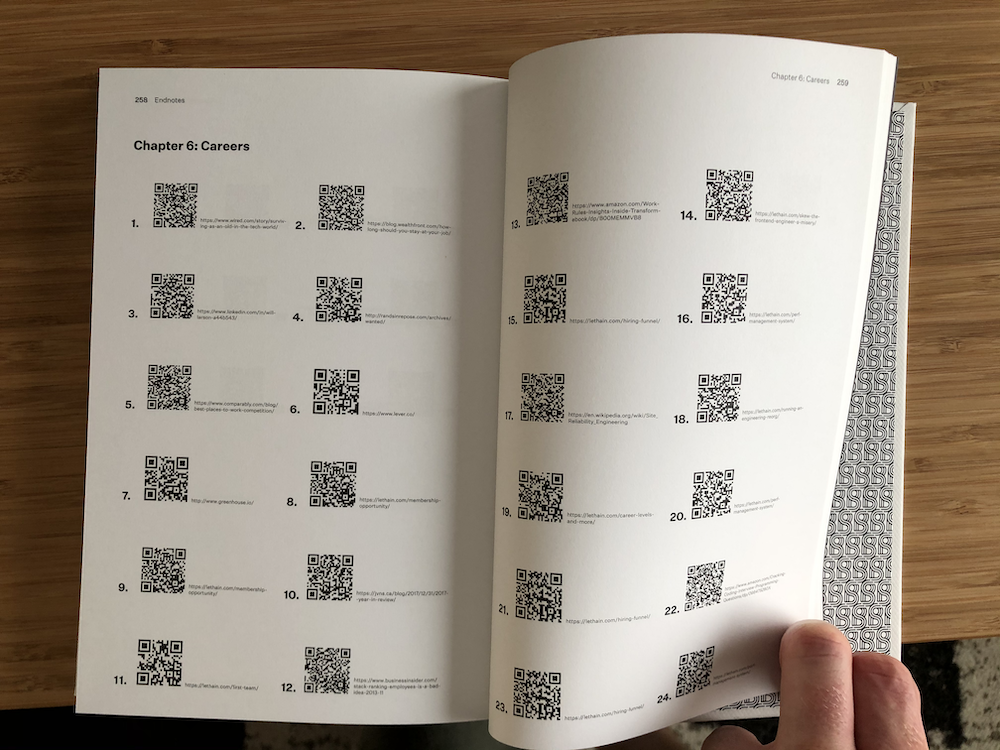
Probably my favorite parts of An Elegant Puzzle is the QR codes we created for each link as an exploration of how print and digital can comingle a bit more easily.
As I start thinking about how to turn staffeng.com into a book, I'm keen to recreate this feature, but even moreso I'm curious if this time I can push it a bit closer to the original vision.
Cool URIs don't change
Ok, so we know that Cool URIs don't change, but now that the book has been out in the wild for over a year, the biggest issue by far has been URLs bit-rotting into 404s. This really highlighted for me how important it is to use a URL shortener to indirect the links, making it possible to fix 404s as links expire.
The other advantage is that QR codes get more complex the longer they are, so simpler ones can be much smaller. For example, let's generate QR codes for these three URLs:
https://lethain.com
https://lethain.com/thisis/a/verylong/url
https://lethain.com/thisis/a/verylong/urlforsomereasonletsjustkeeptyingalothere
Then you can see the corresponding QR codes from left to right, which requrie more and more complexity to represent the underlying URL.

The image complexity matters, because it determines just how small you can get the codes, which in turn impacts either the cost to print or the viability of printing at all.
So, let's 's play around with scaling the images a bit, how small can we get the, such that an iPhone can still read the images?
Let's imagine we can generate a short code for every link in the book and that there are fewer than 10,000 links. Then we can use a URL like this one to reason about rendering sizes.
https://staffeng.com/l/1234
Ok, so looking at it scaled to one, two, three and six pixels,
we can get a sense of various scales (scale is the number of pixels
used to represent a single module within the QRCode).

Even zooming my phone in on my high definition monitor I can't get the smallest QR code to parse, but I can get the second smallest to work reliably, and looking at a printed copy of An Elegant Puzzle, I believe we ended up with a three scale there despite the much longer URLs we were representing.
If you're self-publishing and printing via Kindle Direct Publishing, they print at 300 dots-per-inch, which ought to be more than enough for these images.
Experimenting with format
Ok, now that we have the QRCode sizing, next is to experiment with how to use them. In particular, I want to play around with how to inline them so the QRCodes are close to the link they represent rather than at the end of the book. A compromise would be collecting them all into the end of each chapter rather than the entire book, but inline would be better!
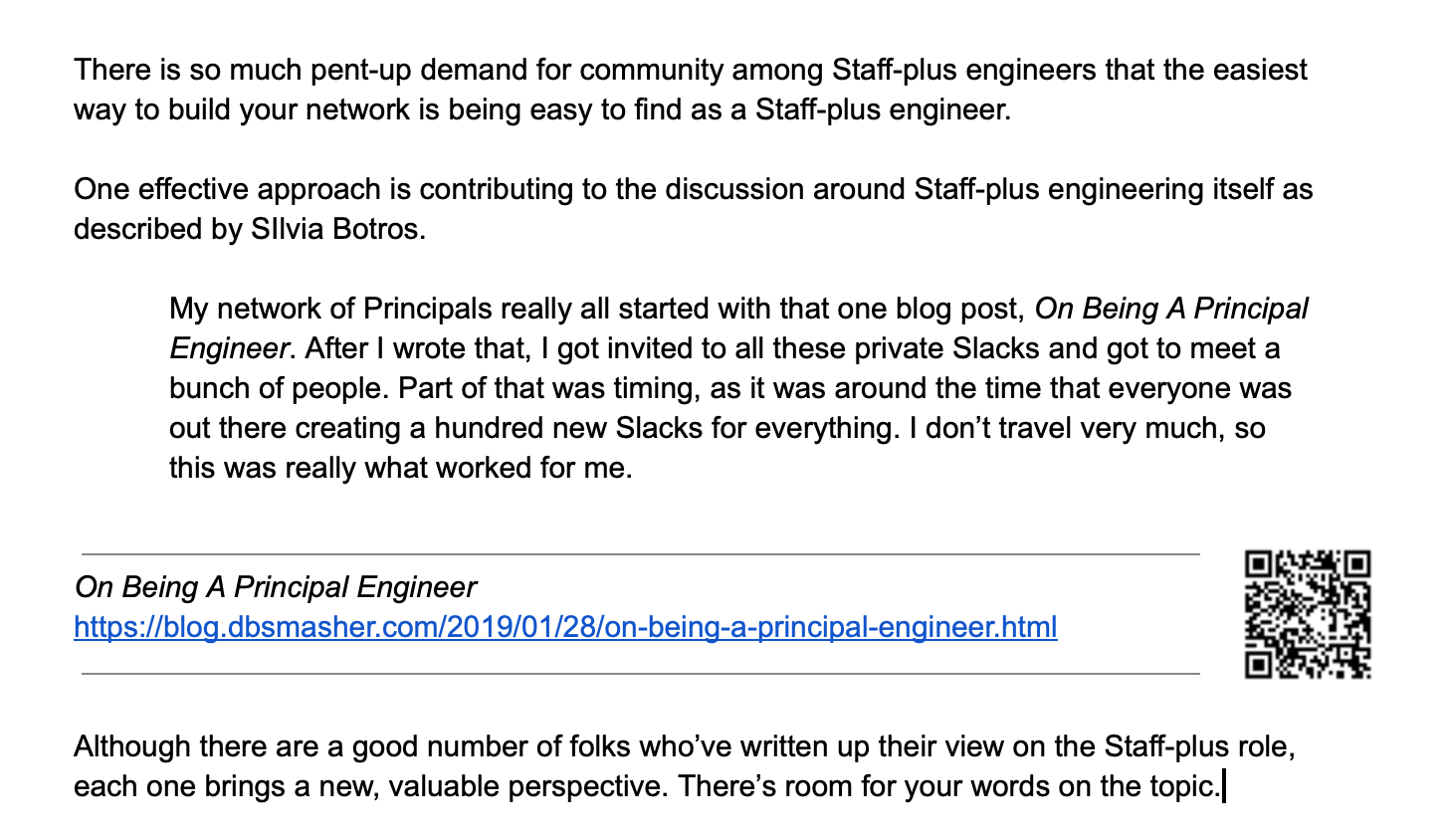
It's a bit verbose though, so interesting to try inlining them even more.
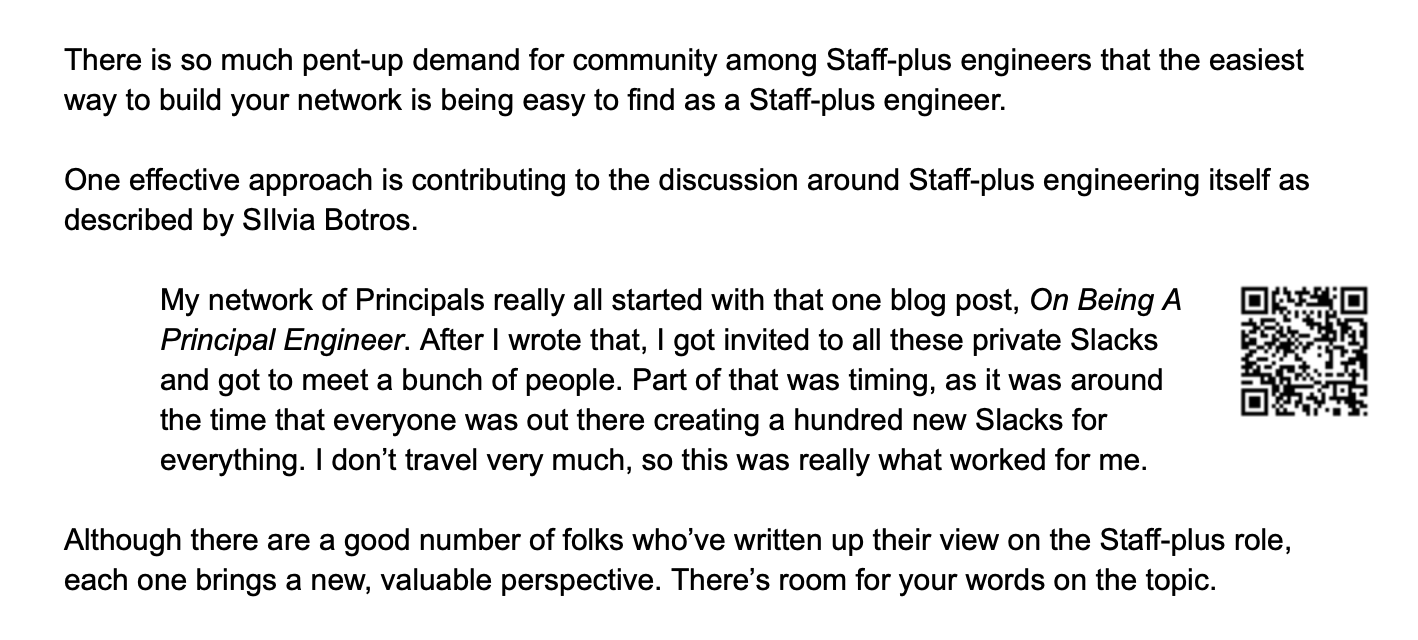
Both of those could work quite nicely, I think, if I can get the layout to work properly, which I suspect will be quite hard! Will see if this is actually possible.
It also makes me have a bunch of other ideas, e.g. should print layout of ever blog post do something similar? An experiment for another time.
Code for QR codes
The script I used for these QRCodes was modeled off this tutorial:
import argparse
import pyqrcode
import png
from pyqrcode import QRCode


def qr(txt):
    code = pyqrcode.create(txt)
    return code


if __name__ == "__main__":
    parser = argparse.ArgumentParser()
    parser.add_argument("text_string", help="text to format, use quotes if whtiespace")
parser.add_argument("output_file", help="filename to render output file")
parser.add_argument("–scale", help="integer representing scale of image", type=int, default=6)
    args = parser.parse_args()
    code = qr(args.text_string)
    code.png(args.output_file, scale=args.scale)
Despite being quite simple, it worked quite well.
That's all for now! Hope to hear your thoughts on Twitter at @lethain!
|

