
How should Stripe deprecate APIs? (~2016) @ Irrational Exuberance
Hi folks,
This is the weekly digest for my blog, Irrational Exuberance. Reach out with thoughts on Twitter at @lethain, or reply to this email.
Posts from this week:
-
How should Stripe deprecate APIs? (~2016)
-
Systems model of API deprecation
How should Stripe deprecate APIs? (~2016)
While Stripe is a widely admired company for things like its creation of the Sorbet typer project, I personally think that Stripe’s most interesting strategy work is also among its most subtle: its willingness to significantly prioritize API stability.
This strategy is almost invisible externally. Internally, discussions around it were frequent and detailed, but mostly confined to dedicated API design conversations. API stability isn’t just a technical design quirk, it’s a foundational decision in an API-driven business, and I believe it is one of the unsung heroes of Stripe’s business success.
This is an exploratory, draft chapter for a book on engineering strategy that I’m brainstorming in #eng-strategy-book. As such, some of the links go to other draft chapters, both published drafts and very early, unpublished drafts.
Reading this document
To apply this strategy, start at the top with Policy. To understand the thinking behind this strategy, read sections in reverse order, starting with Explore.
More detail on this structure in Making a readable Engineering Strategy document.
Policy & Operation
Our policies for managing API changes are:
-
Design for long API lifetime. APIs are not inherently durable. Instead we have to design thoughtfully to ensure they can support change. When designing a new API, build a test application that doesn’t use this API, then migrate to the new API. Consider how integrations might evolve as applications change. Perform these migrations yourself to understand potential friction with your API. Then think about the future changes that we might want to implement on our end. How would those changes impact the API, and how would they impact the application you’ve developed.
At this point, take your API to API Review for initial approval as described below. Following that approval, identify a handful of early adopter companies who can place additional pressure on your API design, and test with them before releasing the final, stable API.
-
All new and modified APIs must be approved by API Review. API changes may not be enabled for customers prior to API Review approval. Change requests should be sent to
api-reviewemail group. For examples of prior art, review theapi-reviewarchive for prior requests and the feedback they received.All requests must include a written proposal. Most requests will be approved asynchronously by a member of API Review. Complex or controversial proposals will require live discussions to ensure API Review members have sufficient context before making a decision.
-
We never deprecate APIs without an unavoidable requirement to do so. Even if it’s technically expensive to maintain support, we incur that support cost. To be explicit, we define API deprecation as any change that would require customers to modify an existing integration.
If such a change were to be approved as an exception to this policy, it must first be approved by the API Review, followed by our CEO. One example where we granted an exception was the deprecation of TLS 1.2 support due to PCI compliance obligations.
-
When significant new functionality is required, we add a new API. For example, we created
/v1/subscriptionsto support those workflows rather than extending/v1/chargesto add subscriptions support.
With the benefit of hindsight, a good example of this policy in action was the introduction of the Payment Intents APIs to maintain
compliance with Europe’s Strong Customer Authentication
requirements. Even in that case the charge API continued to work as it did previously,
albeit only for non-European Union payments.
-
We manage this policy’s implied technical debt via an API translation layer. We release changed APIs into versions, tracked in our API version changelog. However, we only maintain one implementation internally, which is the implementation of the latest version of the API. On top of that implementation, a series of version transformations are maintained, which allow us to support prior versions without maintaining them directly. While this approach doesn’t eliminate the overhead of supporting multiple API versions, it significantly reduces complexity by enabling us to maintain just a single, modern implementation internally.
All API modifications must also update the version transformation layers to allow the new version to coexist peacefully with prior versions.
-
In the future, SDKs may allow us to soften this policy. While a significant number of our customers have direct integrations with our APIs, that number has dropped significantly over time. Instead, most new integrations are performed via one of our official API SDKs.
We believe that in the future, it may be possible for us to make more backwards incompatible changes because we can absorb the complexity of migrations into the SDKs we provide. That is certainly not the case yet today.
Diagnosis
Our diagnosis of the impact on API changes and deprecation on our business is:
-
If you are a small startup composed of mostly engineers, integrating a new payments API seems easy. However, for a small business without dedicated engineers—or a larger enterprise involving numerous stakeholders—handling external API changes can be particularly challenging.
Even if this is only marginally true, we’ve modeled the impact of minimizing API changes on long-term revenue growth, and it has a significant impact, unlocking our ability to benefit from other churn reduction work.
-
While we believe API instability directly creates churn, we also believe that API stability directly retains customers by increasing the migration overhead even if they wanted to change providers. Without an API change forcing them to change their integration, we believe that hypergrowth customers are particularly unlikely to change payments API providers absent a concrete motivation like an API change or a payment plan change.
-
We are aware of relatively few companies that provide long-term API stability in general, and particularly few for complex, dynamic areas like payments APIs. We can’t assume that companies that make API changes are ill-informed. Rather it appears that they experience a meaningful technical debt tradeoff between the API provider and API consumers, and aren’t willing to consistently absorb that technical debt internally.
-
Future compliance or security requirements—along the lines of our upgrade from TLS 1.2 to TLS 1.3 for PCI—may necessitate API changes. There may also be new tradeoffs exposed as we enter new markets with their own compliance regimes. However, we have limited ability to predict these changes at this point.
Systems model of API deprecation
In How should Stripe deprecate APIs?, the diagnosis depends on the claim that deprecating APIs is a significant cause of customer churn. While there is internal data that can be used to correlate deprecation with churn, it’s also valuable to build a model to help us decide if we believe that correlation and causation are aligned in this case.
In this chapter, we’ll cover:
- What we learn from modeling API deprecation’s impact on user retention
- Developing a system model using the lethain/systems package on GitHub. That model is available in the lethain/eng-strategy-models repository
- Exercising that model to learn from it
Time to investigate whether it’s reasonable to believe that API deprecation is a major influence on user retention and churn.
This is an exploratory, draft chapter for a book on engineering strategy that I’m brainstorming in #eng-strategy-book. As such, some of the links go to other draft chapters, both published drafts and very early, unpublished drafts.
Learnings
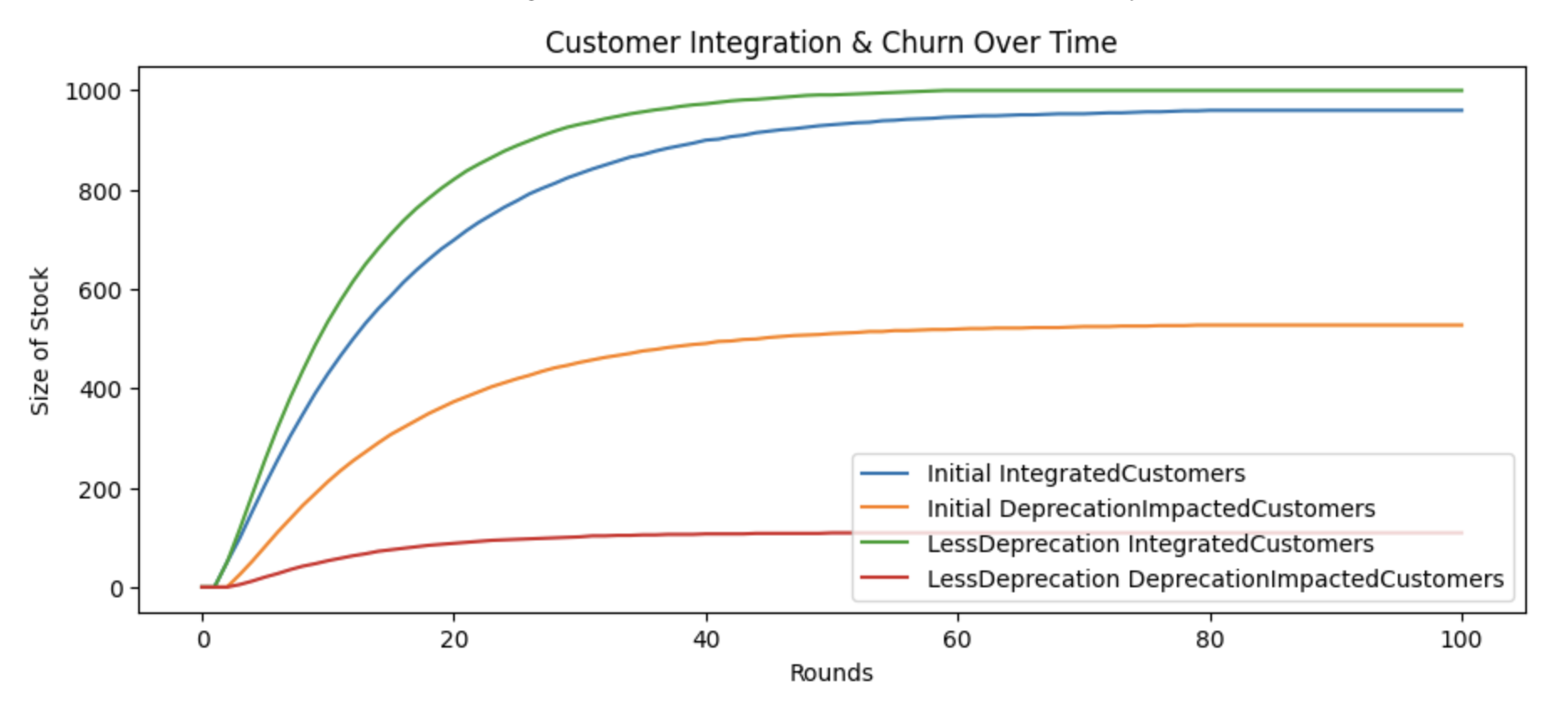
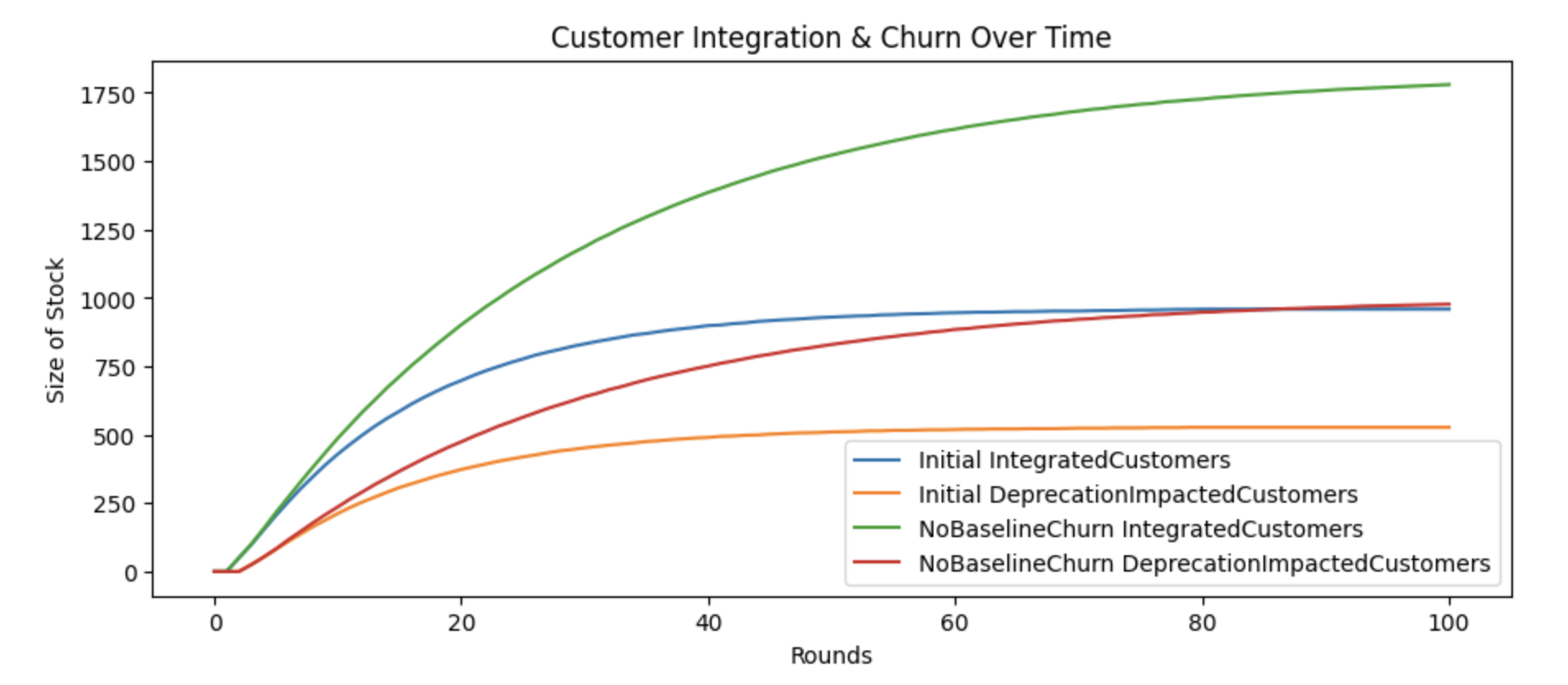
In an initial model that has 10% baseline for customer churn per round, reducing customers experiencing API deprecation from 50% to 10% per round only increases the steady state of integrated customers by about 5%.
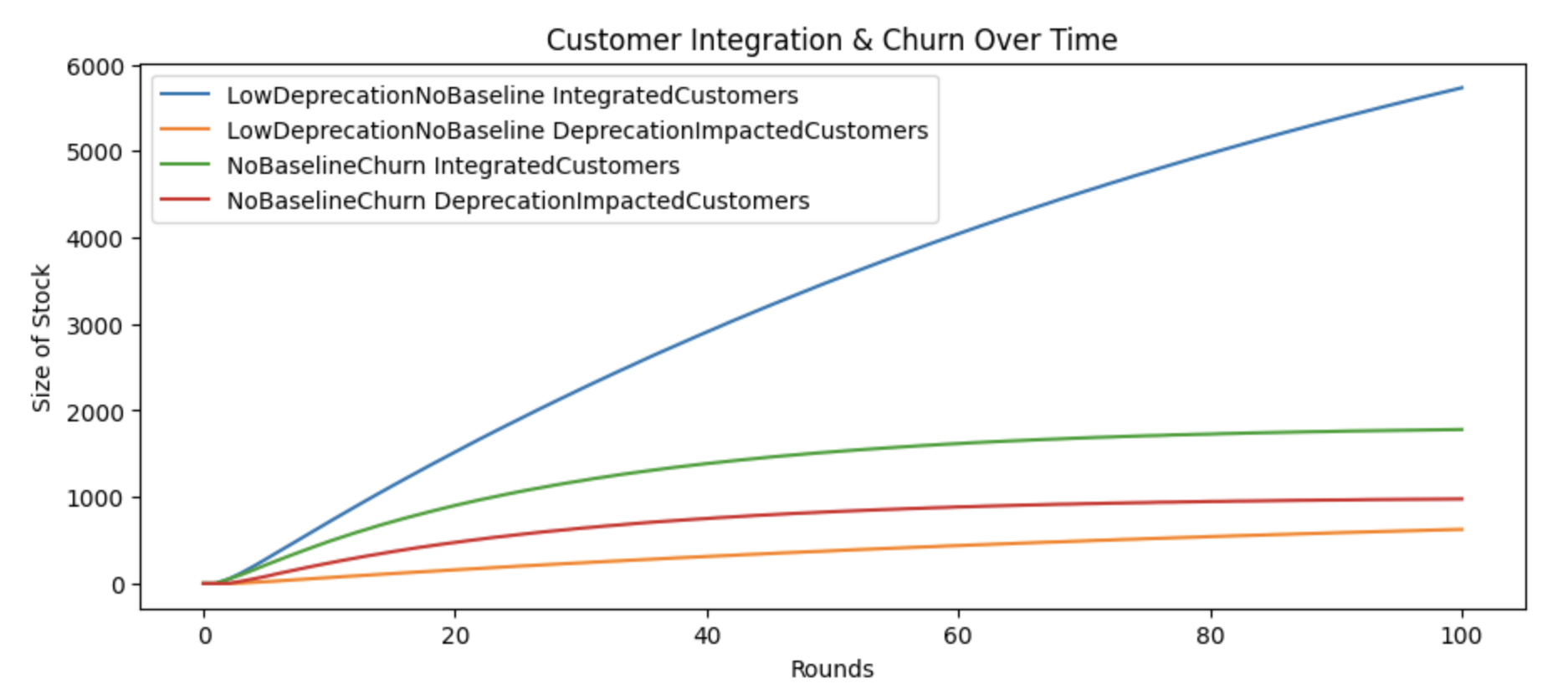
However, if we eliminate the baseline for customer churn entirely, then we see a massive difference between a 10% and 50% rate of API deprecation.
The biggest takeaway from this model is that eliminating API-deprecation churn alone won’t significantly increase the number of integrated customers. However, we also can’t fully benefit from reducing baseline churn without simultaneously reducing API deprecations. Meaningfully increasing the number of integrated customers requires lowering both sorts of churn in tandem.
Sketch
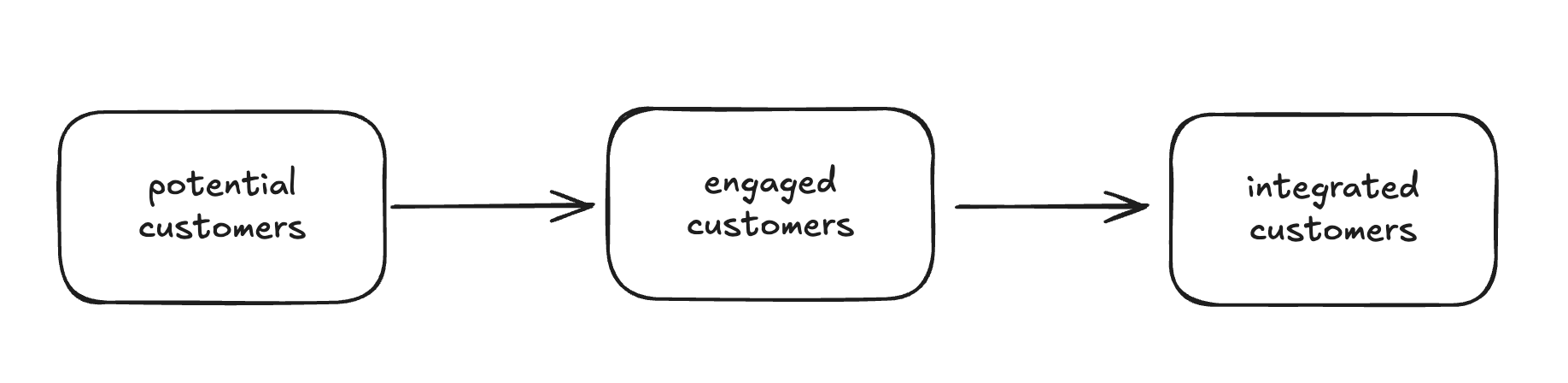
We’ll start by sketching the model’s happiest path: potential customers flowing into engaged customers and then becoming integrated customers. This represents a customer who decides to integrate with Stripe’s APIs, and successfully completes that integration process.
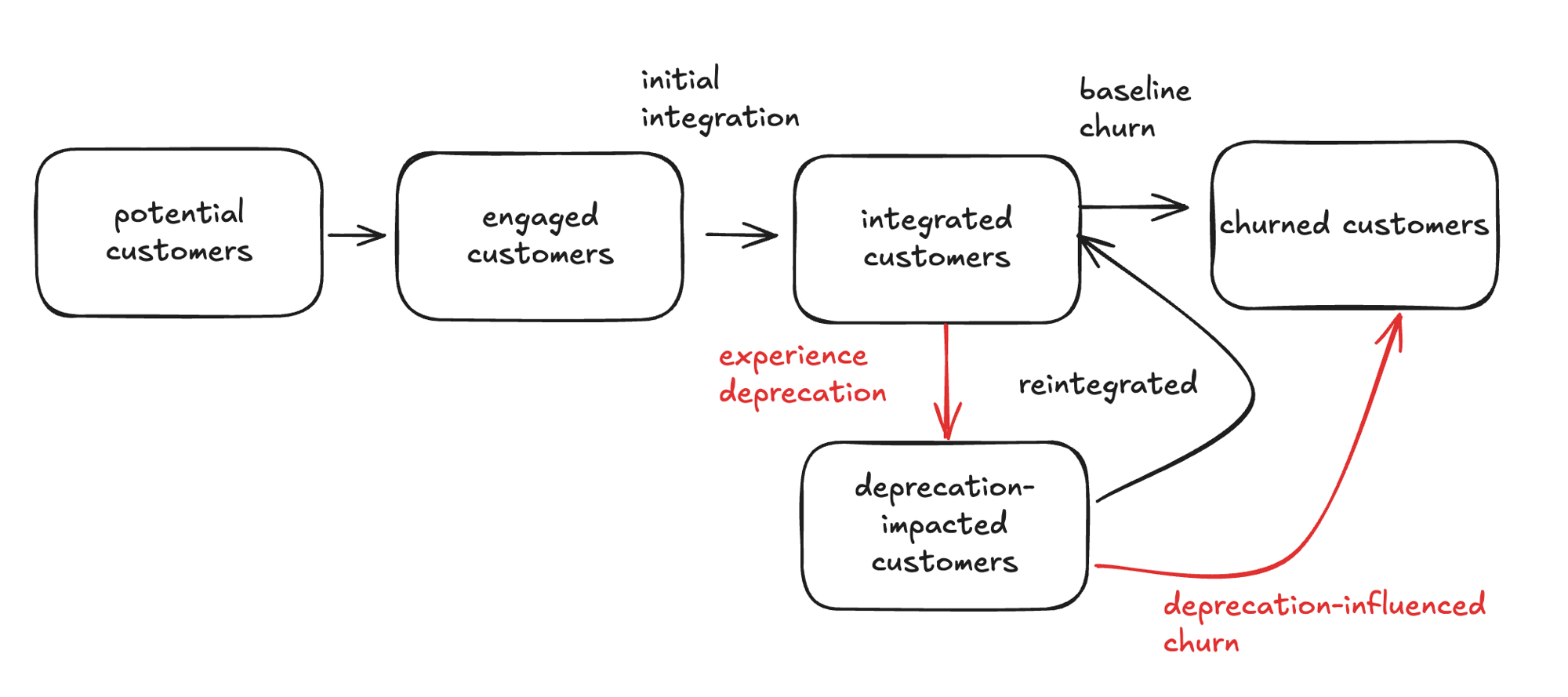
Business would be good if that were the entire problem space. Unfortunately, customers do occasionally churn. This churn is represented in two ways:
baseline churnwhere integrated customers leave Stripe for any number of reasons, including things like dissolution of their companyexperience deprecationfollowed bydeprecation-influenced churn, which represent the scenario where a customer decides to leave after an API they use is deprecated
There is also a flow for reintegration, where a customer impacted by API deprecation
can choose to update their integration to comply with the API changes.
Pulling things together, the final sketch shows five stocks and six flows.
You could imagine modeling additional dynamics, such as recovery of churned customers, but it seems unlikely that would significantly influence our understanding of how API deprecation impacts churn.
Reason
In terms of acquiring customers, the most important flows are customer acquisition and initial integration with the API. Optimizing those flows will increase the number of existing integrations.
The flows driving churn are baseline churn, and the combination of API deprecation and deprecation-influenced churn. It’s difficult to move baseline churn for a payments API, as many churning customers leave due to company dissolution. From a revenue-weighted perspective, baseline churn is largely driven by non-technical factors, primarily pricing. In either case, it’s challenging to impact this flow without significantly lowering margin.
Engineering decisions, on the other hand, have a significant impact on both the number of API deprecations, and on the ease of reintegration after a migration. Because the same work to support reintegration also supports the initial integration experience, that’s a promising opportunity for investment.
Model
You can find the full implementation of this model on GitHub if you want to see the full model rather than these emphasized snippets.
Now that we have identified the most interesting avenues for experimentation, it’s time to develop the model to evaluate which flows are most impactful.
Our initial model specification is:
# User Acquisition Flow
[PotentialCustomers] > EngagedCustomers @ 100
# Initial Integration Flow
EngagedCustomers > IntegratedCustomers @ Leak(0.5)
# Baseline Churn Flow
IntegratedCustomers > ChurnedCustomers @ Leak(0.1)
# Experience Deprecation Flow
IntegratedCustomers > DeprecationImpactedCustomers @ Leak(0.5)
# Reintegrated Flow
DeprecationImpactedCustomers > IntegratedCustomers @ Leak(0.9)
# Deprecation-Influenced Churn
DeprecationImpactedCustomers > ChurnedCustomers @ Leak(0.1)
Whether these are reasonable values depends largely on how we think about the length of each round. If a round was a month, then assuming half of integrated customers would experience an API deprecation would be quite extreme. If we assumed it was a year, then it would still be high, but there are certainly some API providers that routinely deprecate at that rate. (From my personal experience, I can say with confidence that Facebook’s Ads API deprecated at least one important field on a quarterly basis in the 2012-2014 period.)
Admittedly, for a payments API this would be a high rate, and is intended primarily as a contrast with more reasonable values in the exercise section below.
Exercise
Our goal with exercising this model is to understand how much API deprecation impacts customer churn. We’ll start by charting the initial baseline, then move to compare it with a variety of scenarios until we build an intuition for how the lines move.
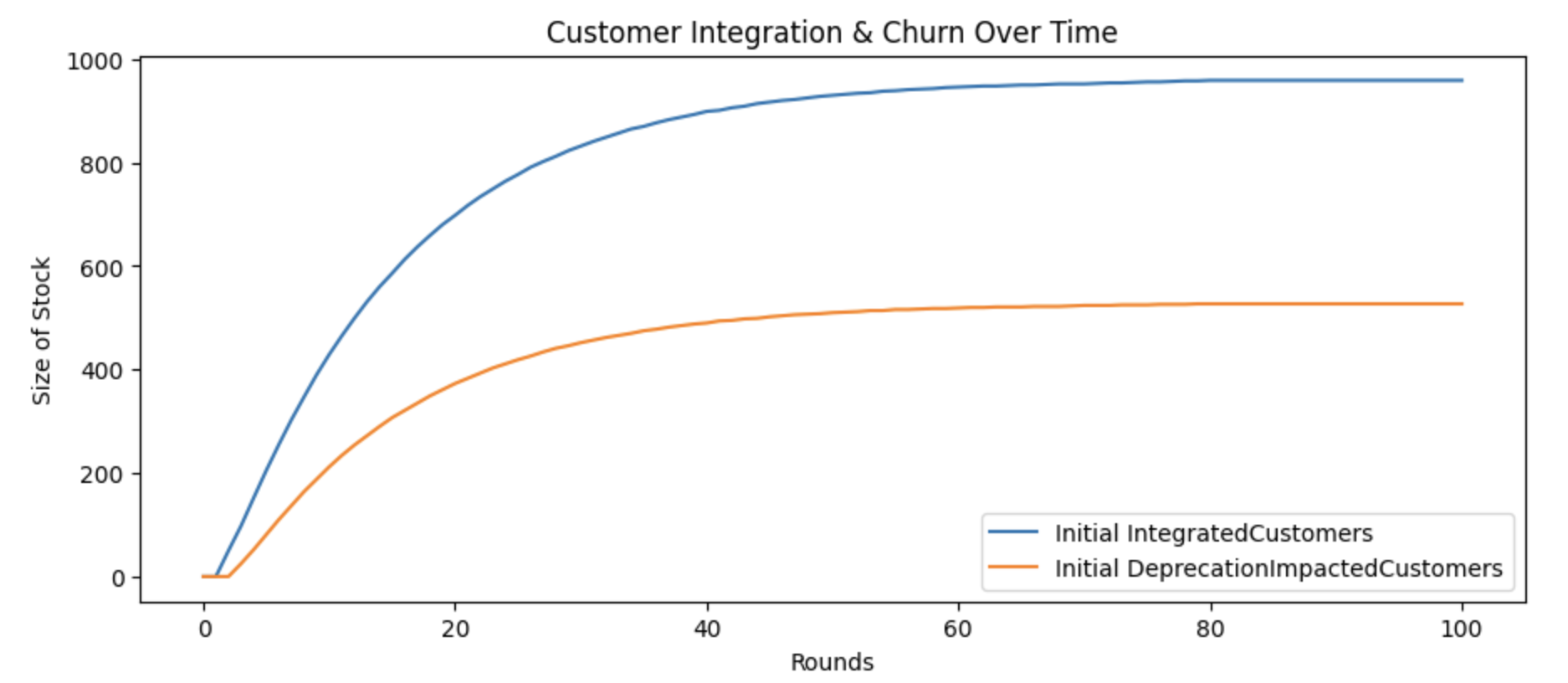
The initial chart stabilizes in about forty rounds, maintaining about 1,000 integrated customers and 400 customers dealing with deprecated APIs. Now let’s change the experience deprecation flow to impact significantly fewer customers:
# Initial setting with 50% experiencing deprecation per round
IntegratedCustomers > DeprecationImpactedCustomers @ Leak(0.5)
# Less deprecation, only 10% experiencing per round
IntegratedCustomers > DeprecationImpactedCustomers @ Leak(0.1)
After those changes, we can compare the two scenarios.
Lowering the deprecation rate significantly reduces the number of companies dealing with deprecations at any given time, but it has a relatively small impact on increasing the steady state for integrated customers. This must mean that another flow is significantly impacting the size of the integrated customers stock.
Since there’s only one other flow impacting that stock, baseline churn, that’s the one to exercise next. Let’s set the baseline churn flow to zero to compare that with the initial model:
# Initial Baseline Churn Flow
IntegratedCustomers > ChurnedCustomers @ Leak(0.1)
# Zeroed out Baseline Churn Flow
IntegratedCustomers > ChurnedCustomers @ Leak(0.0)
These results make a compelling case that baseline churn is dominating the impact of deprecation. With no baseline churn, the number of integrated customers stabilizes at around 1,750, as opposed to around 1,000 for the initial model.
Next, let’s compare two scenarios without baseline churn, where one has high API deprecation (50%) and the other has low API deprecation (10%).
In the case of two scenarios without baseline churn, we can see having an API deprecation rate of 10% leads to about 6,000 integrated customers, as opposed to 1,750 for a 50% rate of API deprecation. More importantly, in the 10% scenario, the integrated customers line shows no sign of flattening, and continues to grow over time rather than stabilizing.
The takeaway here is that significantly reducing either baseline churn or API deprecation magnifies the benefits of reducing the other. These results also reinforce the value of treating churn reduction as a system-level optimization, not merely a collection of discrete improvements.
That's all for now! Hope to hear your thoughts on Twitter at @lethain!
|

