
Irrational Exuberance for 01/30/2019
Hi folks,
This is the weekly digest for my blog, Irrational Exuberance, and these are my posts from the last week. Always grateful to hear your thoughts and suggestions for topics to write about, drop me a tweet or direct message over on Twitter at @lethain.
Read posts on the blog:
-
Growing with your company's complexity.
-
Meeting people.
Growing with your company's complexity.
When finishing up a difficult project, I sometimes pause to dream about how it'll nudge my career forward. My thinking advances down the storyline of "If I bundle this project with a few others, mix in good team health, add a dash of time for the flavor to deepen, and undoubtedly this will get me to the coveted next level."
Then I'll take a few minutes to savor the future.
Dreaming about my career, it's always about the next step forward, operating from the baseline assumption that progress is inevitable. However, in the fast-growing companies I've worked at, this hasn't always been the case. The opportunities arose, but the folks currently doing the work often didn't receive them.
As a business' complexity rapidly grows, folks in important organizational roles often struggle to learn quickly enough to remain effective in their current roles. In such cases, opportunities moved on to someone else who was currently available, often someone newly hired into the company.
The difficulty of retaining your role during rapid growth is usually discussed in hushed tones filtering out from dark corners, but there are some straightforward steps you can take to raise your chances of growing successfully alongside your role's complexity.
From learning to experienced

Everyone has some set of tasks that they're already experienced doing, and another set that they're still learning. In most jobs, you generate value when you're performing tasks you're experienced with, and you're generating future value when you're performing tasks you're learning.
As you learn, you become experienced at more and more tasks, shrinking the learning bucket, and making you more effective in your current role.

In an ideal career, you find yourself progressing up the difficultly curve, such that you are always doing some stuff you're good at, and undertaking some new work. This is the oft-cited stuff of Mihaly Csikszentmihalyi's Flow, and correlates with a rewarding career.
But it's not just you.
There is also the organization around you, and that organization is composed of many other folks who are all learning as well.
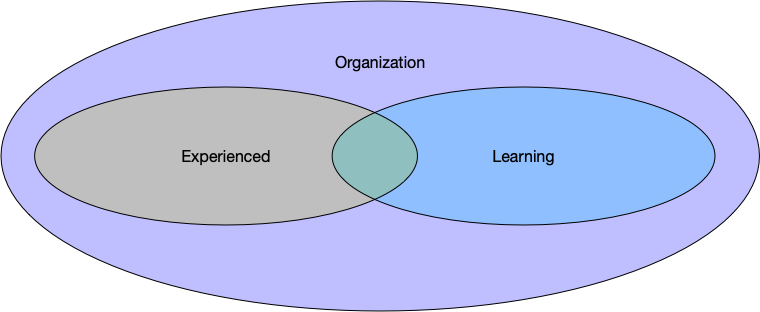
Sometimes, especially early in your career, your learning is entirely within areas the broader organization already knows well. Whenever you have a problem, there are many other folks you can turn to for answers and advice. This is a great place to start out and learn very rapidly. (Depending a bit on your learning style.)
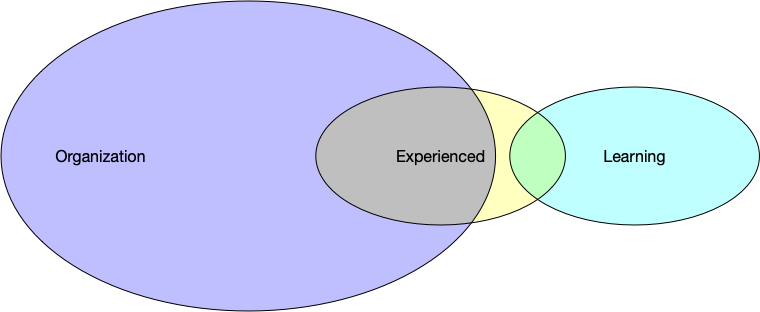
In small companies, or as you get deep into your carer, you often find yourself experienced at tasks that the broader organization is unfamiliar with. This is a tricky time, because the organization depends on you to deliver the work that only you're experienced with, while simultaneously depending on you to rapidly learn new skills that no one in the organization can teach you.
This is when folks start falling behind in their role's growth.
The consequences here are significant. The person in that role will often become a bottleneck on the company's execution, and their rate of learning will decrease even more as they refocus on work they've already mastered. Burning the midnight oil, their excitement for the job will decrease. That frustration will often be compounded by new tasks that still need to get done, but they can't get around to.
If this goes on long enough, the company must hire an external candidate who is either already experienced or has the time to learn.
In a clash of fairness and efficiency, the external candidate doesn't need to be more skilled or experienced than the internal candidate, rather the existance of the internal candidate frees the external hire from performing some set of the tasks, allowing them the space to grow that the internal candidate can't muster.
Typically when the leader of an organization fails to scale with it, they are left in place, while some aspects of the role are shifted away. As a result, it's often the case that any manager's failure to scale with the company can unintentionally cram down an entire organization's career growth.
How do we escape this trap?
Working on the system
Your goal as a leader is to offload work that you are experienced at to the wider organization as rapidly as possible, freeing up room for you to continue learning. The E-Myth Revisited calls this "working on the system," and it's one of the best ways to ensure you're continually shedding tasks that you've become experienced with.
Some examples of high-leverage work that continues to be highly valuable as your role's complexity grows:
- Ensuring your organization's work aligns with your users needs.
- Aligning the approach of teams through visions and strategies.
- Setting goals and metrics to agree on aims and expectations.
- Mentoring and training the team you support.
- Recruiting and hiring folks with missing skillsets.
- Evolving good process and working the exceptions.
- Creating a new program and documenting it for handoff.
If you're spending most of your time on those activities, you're heading in the right direction. Conversely, some examples of getting caught working in the system are:
- Making routine decisions that come up frequently, which I sometimes refer to as working the exceptions.
- Specifying the details of approach for specific teams through tasks, sprints or other single-team artifacts and processes. (Unless you're currently managing a single team!)
- Running a long-standing program that requires your ongoing personal attention to keep functioning.
- Recruiting for roles that need to be hired in volume, and which you've already developed an effective system for hiring.
There is some nuance here. Often you'll hear folks say that they want to be more strategic, and then they stop doing a bunch of critical work. That's not the solution here. The goal is to solve for the work you're experience with, not to abandon it.
Hire experienced people
Sometimes folks start hiring too early and end up bloating their organization with too much management. That's a well-known story and it ends in tears. However, it's life changing to hire a couple of folks who are more experienced than you are, particularly those who are skilled in areas where you're weaker.
Many leaders in fast growing organization are concerned that more experienced folks won't want to report to them, or that they'll get displaced by their more experienced reports. This can happen, but it's almost certainly the case that if you don't hire them, you'll fail to scale with your organization and get layered over anyway.
Learn, learn, learn
Now that you have some strategies to free up your time from existing work, it's time for you have to figure out how to optimize for learning.
Your learning style is very personal, and figuring out how you learn quickly is something that you'll have to spend time figuring out, but I can share what has worked for me:
- The various tasks that comprise "working on the system" let me think about new context and rethink how previous choices fit into that context, and I learn a lot from that.
- Partnering with folks I support and my peers on project to learn from them. When I'm caught up in execution mode, I often try to do work alone to get it done as quickly as possible, but I rarely learn that much. And I'm missing an opportunity to teach.
- Meeting people who are doing similar work at other companies and benchmarking each others' approaches.
- Reading stuff from others who've dealt with the same problems.
- Writing down what I'm struggling with to crystalize my thoughts.
That said, the majority of my learning occurs while working through the challenges of my daily work, and I think that's an important goal to optimize for when trying to learn quickly enough to remain in-role at a growing company.
Trying to do all your learning outside of work is really hard, and in the long run, most folks find that the demands on their time and energy don't support learning outside of work as a means to keep up with this sort of rapidly growing role.
If you're someone in a role that keeps getting more complex, it's normal for it to be difficult. It's normal to make more mistakes than you're comfortable with. It's normal to feel frustrated when thrust towards another new and difficult task.
Certainly some folks have been outgrown by their company, and it'll happen to more folks in the future, but I believe it's far from inevitable. If you keep focused on learning and building systems behind you, then it's possible to scale yourself more and more quickly than I would have ever imagined.
Meeting people.
In the earliest bits of my career, I spent a lot of time worrying that my lack of pedigree was holding me back. How much easier things would have be for me, I imagined, if only I'd attended a feeder school like Stanford or started out at a prestigious company like Google.
Memories of those worries bubbled up when I was chatting with someone at a recent conference, and they asked how I knew so many of the people nearby. My first reaction was that I didn't know very many of the folks, but it's also the case that I know meaningfully more people in my industry today than I did just a few years ago, and that change isn't entirely accidental.
About two years ago, I realized I was encountering more and more problems where I didn't know many folks who could provide advice, and at that point I started to get more intentional at building out my network. I didn't start out with a structured approach, but over time it got clearer what was and what wasn't working.
What I've done is pretty straightforward, and as best I can tell is identical to what other folks do to build their networks:
- Connect with new folks that you don't already know.
- Engage with folks you already know, to keep your relationship strong.
- Compound your network over time through small, ongoing efforts.
The overall approach is fairly simple, I imagine you're already doing something along these lines. Hopefully some of the details of what has worked for me will be useful.
Making initial connections
There are so many ways to meet folks professionally! Some are very effective, but don't scale, like coffee chats. Others are extremely scalable, but only infrequently lead to a strong relationship, like cold sourcing. Ten different folks can try the same approach with ten distinct results, so success stems from figuring out what works well for you personally.
I've experimented with a number of approaches, and here is what I've found most effective for me:
Meeting people at work is by far the most effective way to build a large network. This is one of the easy to miss reasons why it's so valuable to work at a couple of very large or rapidly growing companies. I've personally found rapidly growing companies to be the best environments to meet folks at work, as you and everyone else will be in rapidly evolving roles, and lots of new folks are always starting.
Big companies can often provide a huge base of folks to meet, but it really depends on whether they have ongoing programs to create community across the company. When I worked at Yahoo, it had reached such a large size that many folks didn't interact across teams, which meant that I ended up not meeting too many folks there despite being a company of thirteen thousand.
Your role certainly matters a great deal, with more outwardly facing roles like developer relations making it easier to meet folks even at smaller companies.
- Personal outreach doesn't scale, but it's the most effective way to meet and develop relationships with folks. It's easiest to get an introduction from someone I know, but even without, a short friendly email that asks a concise, interesting and relevant question almost always leads to a friendly new acquaintance. Sometimes this doesn't work and you get ignored, which is totally fine. A big part of networking is getting comfortable with the fact that other folks are living their own lives, and sometimes are too busy to even respond to your note. It's never personal.
- Hiring and interviewing is highly underrated as a way to meet fascinating people that you can learn from. Particularly when interviewing at a fast-growing company, I've first met a staggering number of amazing folks by interviewing them. Cold sourcing is another aspect of recruiting that has helped me met many folks.
- Blogging on this blog, Irrational Exuberance, is where I've channeled by far the most effort. In a perfect world, I'd be able to report that it's been my leading source of connections, but so far that definitively untrue. Anecdotally, I feel like this might be on the cusp of changing if I continue writing at high-volume, but even then it would only be becoming true after a decade of writing.
- Social media is the most active mechanism I use for meeting folks, typically paired with using it as a distribution channel for my writing. The only novel observation I have to share here is that I think every social network works well in different ways, e.g. I personally am loathe to share stuff to Facebook, but I've seen others use it to great effect (especially private groups). On the other hand, most folks are skeptical of LinkedIn as a platform, but for me it generate a great deal of engagement, and second only to Twitter.
- Speaking at conferences has worked well for me lately, although it took me almost a decade of my career before I felt I had enough interesting things to say, the public speaking experience to say them well, and was in the right sort of professional role where investing energy into conference speaking was aligned with the needs of the business. That said, I've always met a bunch of fascinating folks when I speak, and I've found it quite effective. It's particularly effective in contrast with attending conferences, which I've personally found rather ineffective for building relationships. (Although I'll readily admit that this is in large part a function of how I work best, and they seem to work very well for some others.)
- Writing a book is my most focused attempt at reaching a wider audience than my work or my blog. It's far too early to imagine how this will work out, but I'm cautiously optimistic, and will write more as things unwind.
- Speaking on podcasts is something I experimented with last year, and I think they're an effective way to reach new audiences of folks, some of whom will pop up for a discussion with you later. The ones I've done so far haven't generated too many connections, but they tend to be a small commitment of time (for the guest speaker, not the producer!), which makes them effective.
- Meetups are difficult for me personally, as I'm introverted enough that by the end of the day I want to go home and recharge. However, I've met other folks who find them quite effective. Along the same lines as attending conferences, I've felt more comfortable attending as a speaker, where folks engage with you directly, than as an attendee.
- My college network has not been very effective for me, as I attended a small college in Kentucky. However, I know that for some folks their college network is extremely impactful, especially for folks from various feeding schools like Stanford, MIT or CMU.
I'm very certain that you'll find that this ordering doesn't hold true for you. Give the different approaches a try, and find your own ranking!
Staying engaged
When it's ignored, your professional network decays gradually over time, so it's important to continue to keep in touch with folks, not assuming that you can pop up for a favor years later.
Fortunately, most of the activities that are good for making initial connections also work well for staying engaged. For me personally, I've found that blogging, engaging on social media, and conference speaking have been quite effective at both. I also know that others find meetups to work well.
Many of the folks who've mastered networking at scale, like patio11 and Andrew Chen, are very focused on weekly newsletters, to the extent that I recently decided to try creating one myself. It's important to recognize though, what I've done is put up a mailing list that reads off this blog's RSS feed. What those two have done is build high quality products that happen to masquerade as mailing lists, and I suspect that success with this approach requires a great deal of focused intention.
That said, the most reliable ways to stay in touch with folks are the most obvious: send them a thoughtful note, or meet them a couple times a year for coffee. I've not used one myself, but I've heard folks mention that they've set up a personal CRM to help them manage reengagement.
When identifying an approach that will work well for you, the most important criteria is that it's something you're able to continue doing over the long run. It's easy to overcommit, starting strong but quitting early, and this is an area where small continual investments trump the occasional frantic outreach.
Compounding gains
Like most important endeavours, building a good relationship with a large number of folks requires years of ongoing effort. In the beginning, it'll feel ineffective, and it will only slowly change to feeling easier. For me, it still doesn't feel easy, although I remain hopeful that it'll continue to get easier.
What works for me is to set very achievable goals for myself that ensure I remain engaged over time. For 2018, I set two goals: (1) write a blog post at least once a month, and (2) meet at least one new infrastructure engineering leader each quarter. In my current role and with my writing habit, these were easy goals to hit, and that was the point. The slow continued build is what's important.
It's also true that the occasional spike of activity is useful to accelerate this process, as long as you don't overdo it so much that you subsequently have no energy for maintenance. For me, that spike has been writing my book and doing a bit more public speaking, but I expect both to slow down soon, and don't imagine either to be major, sustainable parts of how I meet and stay engaged with folks.
The lesson to walk away with is that building relationships is something that happens over years of intentional efforts. Don't get discouraged if you feel invisible in your industry, almost everyone feels this way. Instead find a way that's authentic and rewarding for you to slowly swell, expanding and maintaining the group of folks you can learn with along the way.
That's all for now! Hope to hear your thoughts on Twitter at @lethain!
|