
Script for consistent linking within book. @ Irrational Exuberance
Hi folks,
This is the weekly digest for my blog, Irrational Exuberance. Reach out with thoughts on Twitter at @lethain, or reply to this email.
Posts from this week:
-
Script for consistent linking within book.
-
How to resource Engineering-driven projects at Calm? (2020)
Script for consistent linking within book.
As part of my work on #eng-strategy-book, I’ve been editing a bunch of stuff. This morning I wanted to work on two editing problems. First, I wanted to ensure I was referencing strategies evenly across chapters (and not relying too heavily on any given strategy). Second, I wanted to make sure I was making references to other chapters in a consistent, standardized way,
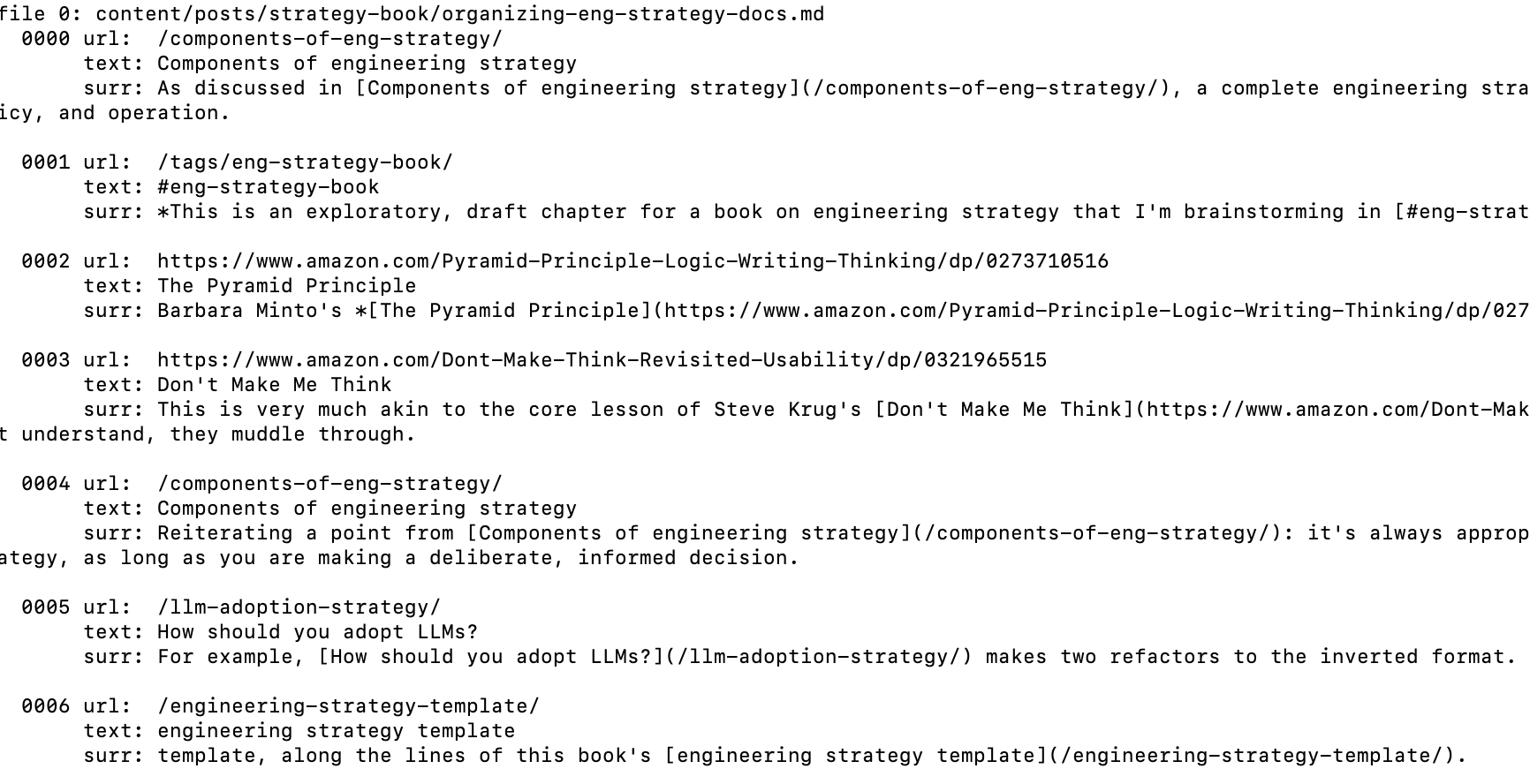
Both of these are collecting Markdown links from files, grouping those links by either file or url, and then outputting the grouped content in a useful way. I decided to experiment with writing a one-shot prompt to write the script for me rather than writing it myself. The prompt and output (from ChatGPT 4.5) are available in this gist.
That worked correctly! The output was a bit ugly, so I tweaked the output slightly by hand, and also adjusted the regular expression to capture less preceding content, which resulted in this script. Although I did it by hand, I’m sure it would have been faster to just ask ChatGPT to fix the script itself, but either way these are very minor tweaks.
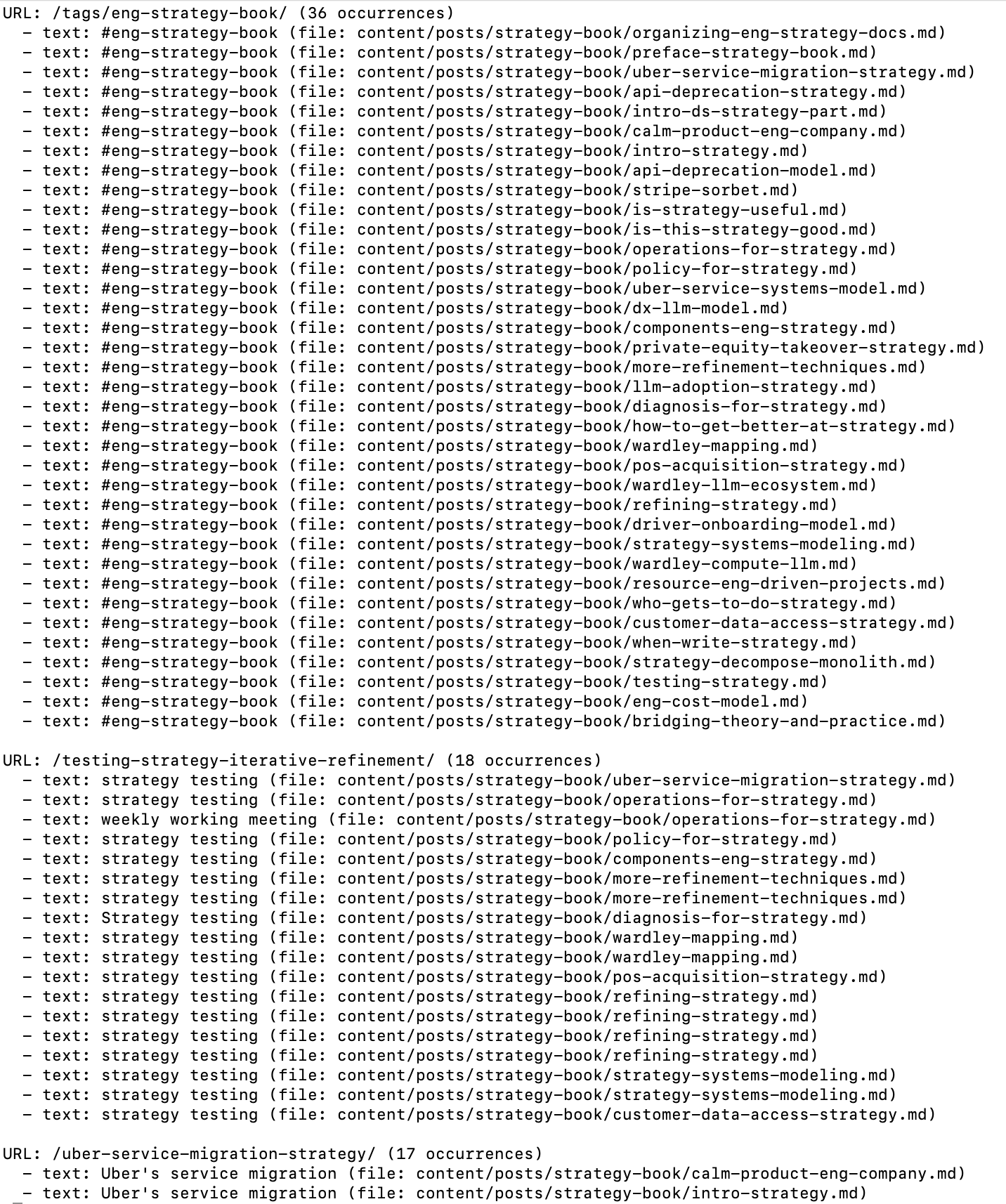
Now I can call the script in either standard of --grouped mode.
Example of ./scripts/links.py "content/posts/strategy-book/*.md" output:
Example of ./scripts/links.py "content/posts/strategy-book/*.md" --grouped output:
Altogether, this is a super simple script that I could have written in thirty minutes or so, but this allowed me to write it in less than ten minutes, and get back to actually editing with the remaining twenty.
It’s also quite helpful for solving the intended problem of imbalanced references to strategies. Here you can see I initially had 17 references to the Uber migration strategy, which was one of the first strategies I documented for the book.
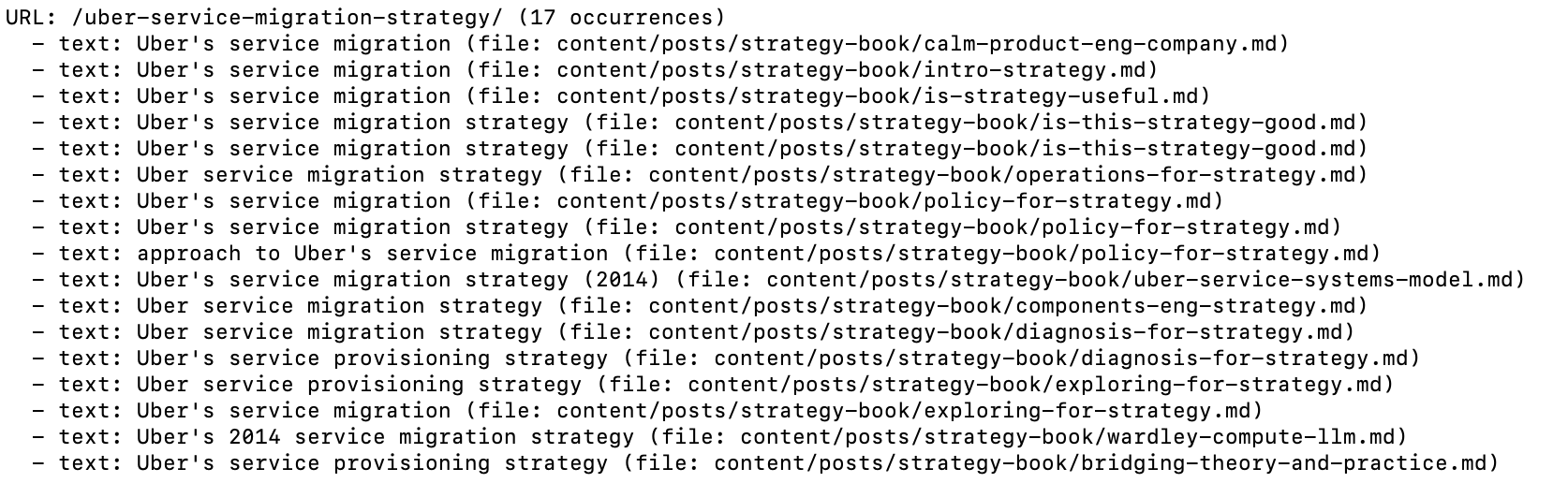
On the other hand, the strategy for Stripe’s Sorbet only had three links because it was one of the last two chapters I finished writing.

It’s natural that I referenced existing strategies more frequently than unwritten strategies over the course of drafting chapters, but it makes the book feel a bit lopsided when read, and this script has helped me address the imbalance. This is something I didn’t do in Staff Engineer, but wish I had, as I ended up leaning a bit too heavily on early stories and mentioned later stories less frequently.
How to resource Engineering-driven projects at Calm? (2020)
One of the recurring challenges in any organization is how to split your attention across long-term and short-term problems. Your software might be struggling to scale with ramping user load while also knowing that you have a series of meaningful security vulnerabilities that need to be closed sooner than later. How do you balance across them?
These sorts of balance questions occur at every level of an organization. A particularly frequent format is the debate between Product and Engineering about how much time goes towards developing new functionality versus improving what’s already been implemented. In 2020, Calm was growing rapidly as we navigated the COVID-19 pandemic, and the team was struggling to make improvements, as they felt saturated by incoming new requests. This strategy for resourcing Engineering-driven projects was our attempt to solve that problem.
This is an exploratory, draft chapter for a book on engineering strategy that I’m brainstorming in #eng-strategy-book. As such, some of the links go to other draft chapters, both published drafts and very early, unpublished drafts.
Reading this document
To apply this strategy, start at the top with Policy. To understand the thinking behind this strategy, read sections in reverse order, starting with Explore.
More detail on this structure in Making a readable Engineering Strategy document.
Policy & Operation
Our policies for resourcing Engineering-driven projects are:
- We will protect one Eng-driven project per product engineering team, per quarter. These projects should represent a maximum of 20% of the team’s bandwidth. Each project must advance a measurable metric, and execution must be designed to show progress on that metric within 4 weeks.
- These projects must adhere to Calm’s existing Engineering strategies.
- We resource these projects first in the team’s planning, rather than last. However, only concrete projects are resourced. If there’s no concrete proposal, then the team won’t have time budgeted for Engineering-driven work.
- Team’s engineering manager is responsible for deciding on the project, ensuring the project is valuable, and pushing back on attempts to defund the project.
- Project selection does not require CTO approval, but you should escalate to the CTO if there’s friction or disagreement.
- CTO will review Engineering-driven projects each quarter to summarize their impact and provide feedback to teams’ engineering managers on project selection and execution. They will also review teams that did not perform a project to understand why not.
As we’ve communicated this strategy, we’ve frequently gotten conceptual alignment that this sounds reasonable, coupled with uncertainty about what sort of projects should actually be selected. At some level, this ambiguity is an acknowledgment that we believe teams will identify the best opportunities bottoms-up, we also wanted to give two concrete examples of projects we’re greenlighting in the first batch:
-
Code-free media release: historically, we’ve needed to make a number of pull requests to add, organize, and release new pieces of media. This is high urgency work, but Engineering doesn’t exercise much judgment while doing it, and manual steps often create errors. We aim to track and eliminate these pull requests, while also increasing the number of releases that can be facilitated without scaling the content release team.
-
Machine-learning content placement: developing new pieces of media is often a multi-week or month process. After content is ready to release, there’s generally a debate on where to place the content. This matters for the company, as this drives engagement with our users, but it matters even more to the content creator, who is generally evaluated in terms of their content’s performance.
This often leads to Product and Engineering getting caught up in debates about how to surface particular pieces of content. This project aims to improve user engagement by surfacing the best content for their interests, while also giving the Content team several explicit positions to highlight content without Product and Engineering involvement.
Although these projects are similar, it’s not intended that all Engineering-driven projects are of this variety. Instead it’s happenstance based on what the teams view as their biggest opportunities today.
Diagnosis
Our assessment of the current situation at Calm is:
-
We are spending a high percentage of our time on urgent but low engineering value tasks. Most significantly, about one-third of our time is going into launching, debugging, and changing content that we release into our product. Engineering is involved due to limitations in our implementation, not because there is any inherent value in Engineering’s involvement. (We mostly just make releases slowly and inadvertently introduce bugs of our own.)
-
We have a bunch of fairly clear ideas around improving the platform to empower the Content team to speed up releases, and to eliminate the Engineering involvement. However, we’ve struggled to find time to implement them, or to validate that these ideas will work.
-
If we don’t find a way to prioritize, and succeed at implementing, a project to reduce Engineering involvement in Content releases, we will struggle to support our goals to release more content and to develop more product functionality this year
-
Our Infrastructure team has been able to plan and make these kinds of investments stick. However, when we attempt these projects within our Product Engineering teams, things don’t go that well. We are good at getting them onto the initial roadmap, but then they get deprioritized due to pressure to complete other projects.
-
Engineering team is not very fungible due to its small size (20 engineers), and because we have many specializations within the team: iOS, Android, Backend, Frontend, Infrastructure, and QA. We would like to staff these kinds of projects onto the Infrastructure team, but in practice that team does not have the product development experience to implement theis kind of project.
-
We’ve discussed spinning up a Platform team, or moving product engineers onto Infrastructure, but that would either (1) break our goal to maintain joint pairs between Product Managers and Engineering Managers, or (2) be indistinguishable from prioritizing within the existing team because it would still have the same Product Manager and Engineering Manager pair.
-
Company planning is organic, occurring in many discussions and limited structured process. If we make a decision to invest in one project, it’s easy for that project to get deprioritized in a side discussion missing context on why the project is important.
These reprioritization discussions happen both in executive forums and in team-specific forums. There’s imperfect awareness across these two sorts of forums.
Explore
Prioritization is a deep topic with a wide variety of popular solutions. For example, many software companies rely on “RICE” scoring, calculating priority as (Reach times Impact times Confidence) divided by Effort. At the other extreme are complex methodologies like [Scaled Agile Framework)(https://en.wikipedia.org/wiki/Scaled_agile_framework).
In addition to generalized planning solutions, many companies carve out special mechanisms to solve for particular prioritization gaps. Google historically offered 20% time to allow individuals to work on experimental projects that didn’t align directly with top-down priorities. Stripe’s Foundation Engineering organization developed the concept of Foundational Initiatives to prioritize cross-pillar projects with long-term implications, which otherwise struggled to get prioritized within the team-led planning process.
All these methods have clear examples of succeeding, and equally clear examples of struggling. Where these initiatives have succeeded, they had an engaged executive sponsoring the practice’s rollout, including triaging escalations when the rollout inconvenienced supporters of the prior method. Where they lacked a sponsor, or were misaligned with the company’s culture, these methods have consistently failed despite the fact that they’ve previously succeeded elsewhere.
That's all for now! Hope to hear your thoughts on Twitter at @lethain!
|

